
Home / Rare Antiques
Rare Antiques
A considered selection of antique provincial furniture, continental ceramics and School of Paris paintings, representing the finest examples across our stock. Spanning France, Italy and the Low Countries, each piece is chosen for its rarity, craftsmanship and decorative presence.
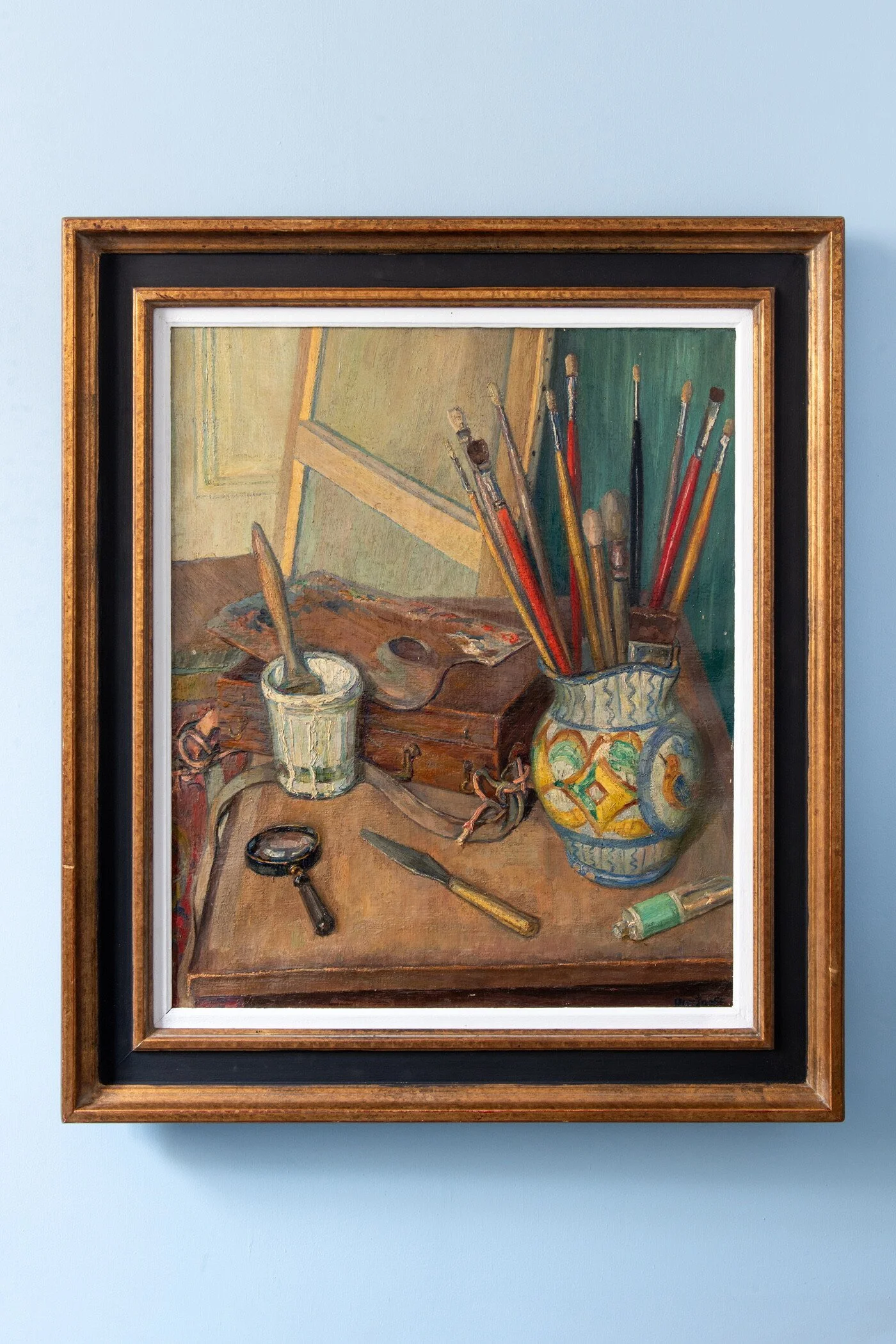
An oil painting on canvas by French-Ukrainian artist Michel Portnoff (1885-1978), c. 1950-60, depicting a still life with artist's brushes contained in a jug, along with a palette knife, magnifier, a brush in pot, a painter's palette and a wooden studio case, all laid on a rustic table. The scene is set in an interior with an antique carpet to the left, stretchers and a door in the background.
Earthy tones dominate the composition, making the colours of the brushes, the white of the pot, and the blue and yellow of the jug stand out. Strong architectural lines give rhythm to the work, from the vertical of the brushes to the horizontal of the table, set against the oblique of the stretchers and case.
The handpainted faience jug, with its bird, geometric motifs and wavy lines, adds character and a sense of place through its folk decoration. Impasto brushwork renders the varied materials with tactile realism, from the reflection of light on the magnifier to the wood of the table and case, and the oil paint itself.
Signed lower right and presented in a period black and gilded frame. An impressive work with substantial presence, offering a refined study of the painter’s environment and introspective glimpse into his creative space.
Born in 1885 in Elizavetgrad (then Russian Empire, now Kropyvnytskyi, Ukraine), Portnoff studied at the Odessa School of Art and lived in Florence for approximately twenty years before settling in Paris in 1929. He regularly exhibited at the Salon d'Automne and the Salon des Indépendants, with a solo exhibition at the Simonson gallery in 1935. Commemorative exhibitions were held in Paris in 1979 and 1984.
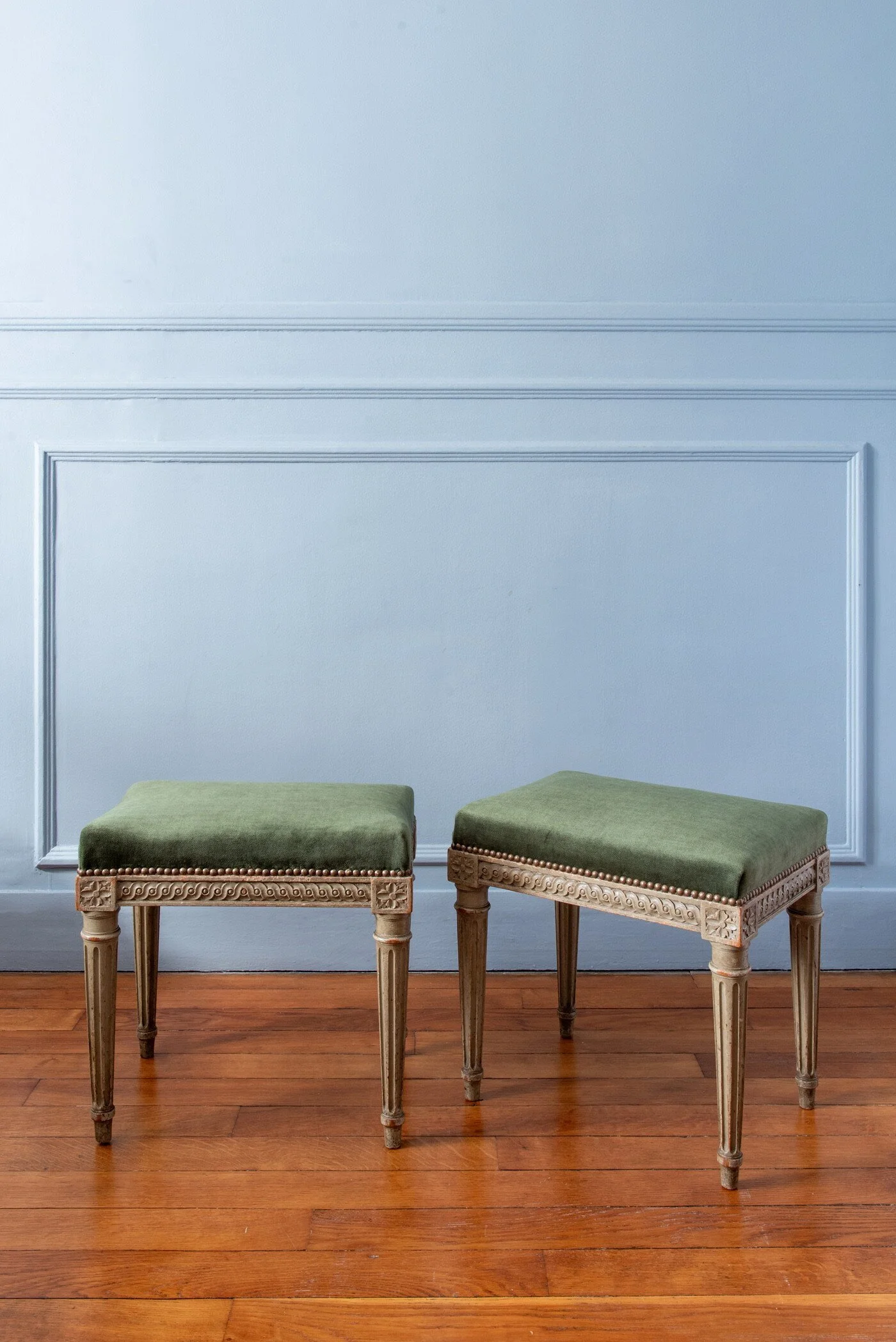
A pair of 19th-century French painted stools in the Louis XVI style, with slender fluted rounded legs. The frieze features interlaced beaded ornament along with paterae on the corners with carved flowers.
The original paint finish in a dark shade of off-white is softly patinated, and the stools have been newly upholstered in green Nobilis velvet.
A rare pair with restrained elegance and architectural presence. The exquisite carving, balanced proportions and harmonious colour make these versatile stools well suited to a living room or bedroom as occasional seating.
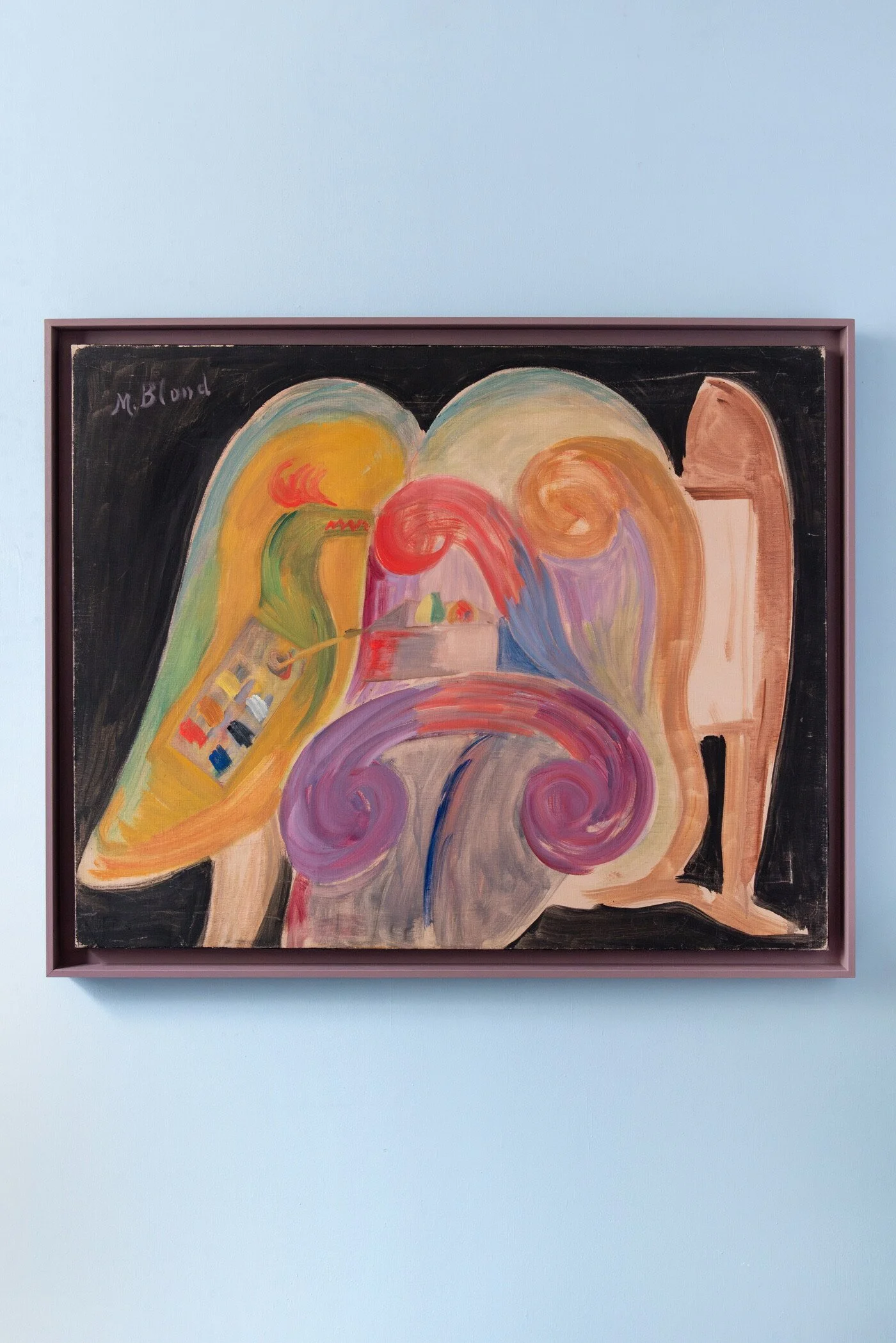
A late work by French-Polish artist Maurice Blond (Lodz, 1899 – Clamart, 1974), executed in 1974. The painting presents a dreamlike vision of the artist's studio, depicting a fantastical creature wielding brush and palette before a still life of fruits upon a table. The enigmatic subject is enveloped by sweeping abstract waves and scrolls set against a black ground, creating a composition that bridges figuration and abstraction.
The work employs a distinctive palette of dusty purple and light brown, punctuated by richer accents of red, yellow and green. Blond's expressive brushwork animates the flowing scrolls and background, while finer strokes articulate the palette and the creature's teeth, adding figurative detail to the broader gestural forms. The composition is further animated by pattern—from the undulating scrolls to the zigzag of teeth and the geometric divisions of the palette.
While Blond’s early works encompassed streetscapes, still lifes and portraits, his later output increasingly focused on the quiet elements of studio life: fruits on tables, chairs, and the painter's palette itself. This rare and compelling work synthesises these familiar motifs whilst introducing a fantastical element—a creature both playful and enigmatic—revealing everyday artistic practice as both mysterious and imaginative.
Signed upper left and dated on a stretcher bar on the reverse. Newly fitted in a painted tray frame, in the manner of those used by the artist for his later works.
Born in Lodz, Poland, in 1899, Maurice Blond’s early engagement with art drew notice when in 1911 when one of his watercolours was exhibited at the Kiev museum. Studying natural sciences first, he took classes at the Warsaw School of Fine Arts and left for Berlin in 1923 where he met Isaac Mintchine and Kostia Terechkovitch. He arrived in Paris in 1924, settling at the artist’s colony La Cité Falguiere near Montparnasse and becoming friends with Russian artists such as Pinchus Krémegne and Natalia Goncharova. After WWII, he settled in Grenoble and dedicated his time exclusively to painting. Blond exhibited at the Salon des Independents (1926) and Salon des Tuileries (1930), followed by numerous gallery exhibitions in Paris, most notably at Weil (1960), Durand-Ruel (1961) and Kriegel (1971).
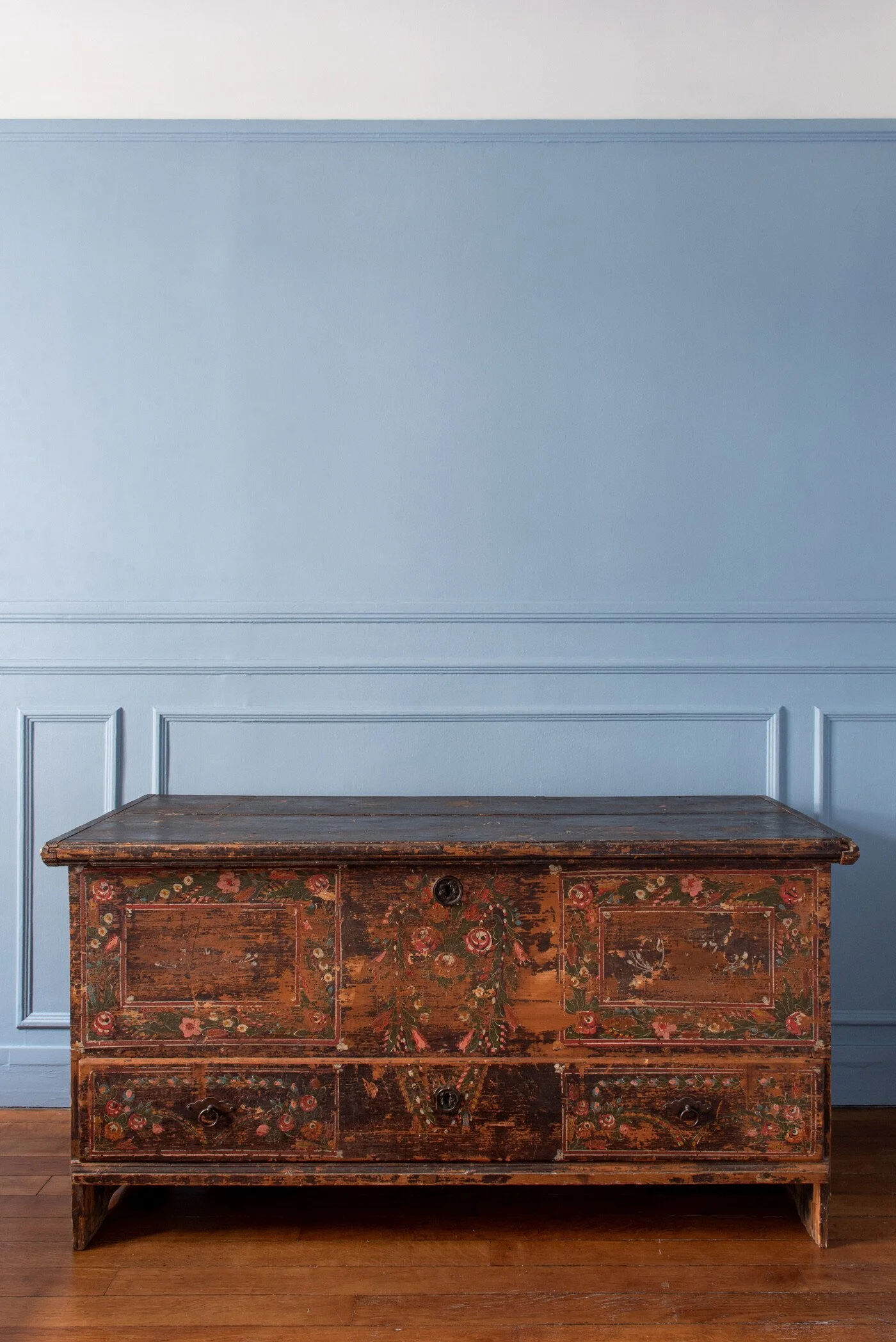
A late 18th-century Alpine folk marriage chest in hand-painted fir, c. 1780, possibly Swiss or Austrian Tyrol. The upper section opens from the top, while the lower section features a large drawer.
The front is decorated with finely painted garlands of roses, trailing foliage and scattered flowers set within architectural reserves, while a looser floral garland surrounds the original central locks. The painted decoration displays vivid red and pink roses, blue flowers and green foliage, with white highlights against a warm ochre ground. The composition depicts a variety of floral species, rendered in the confident vernacular style characteristic of rural Alpine painters of the late 18th century.
The chest stands on elegantly shaped bracket feet, adding lightness to its tall, rectangular form. Both practical and decorative, it offers generous storage while serving as a striking interior piece. A rare Alpine folk marriage chest with distinctive patina and strong vernacular character.
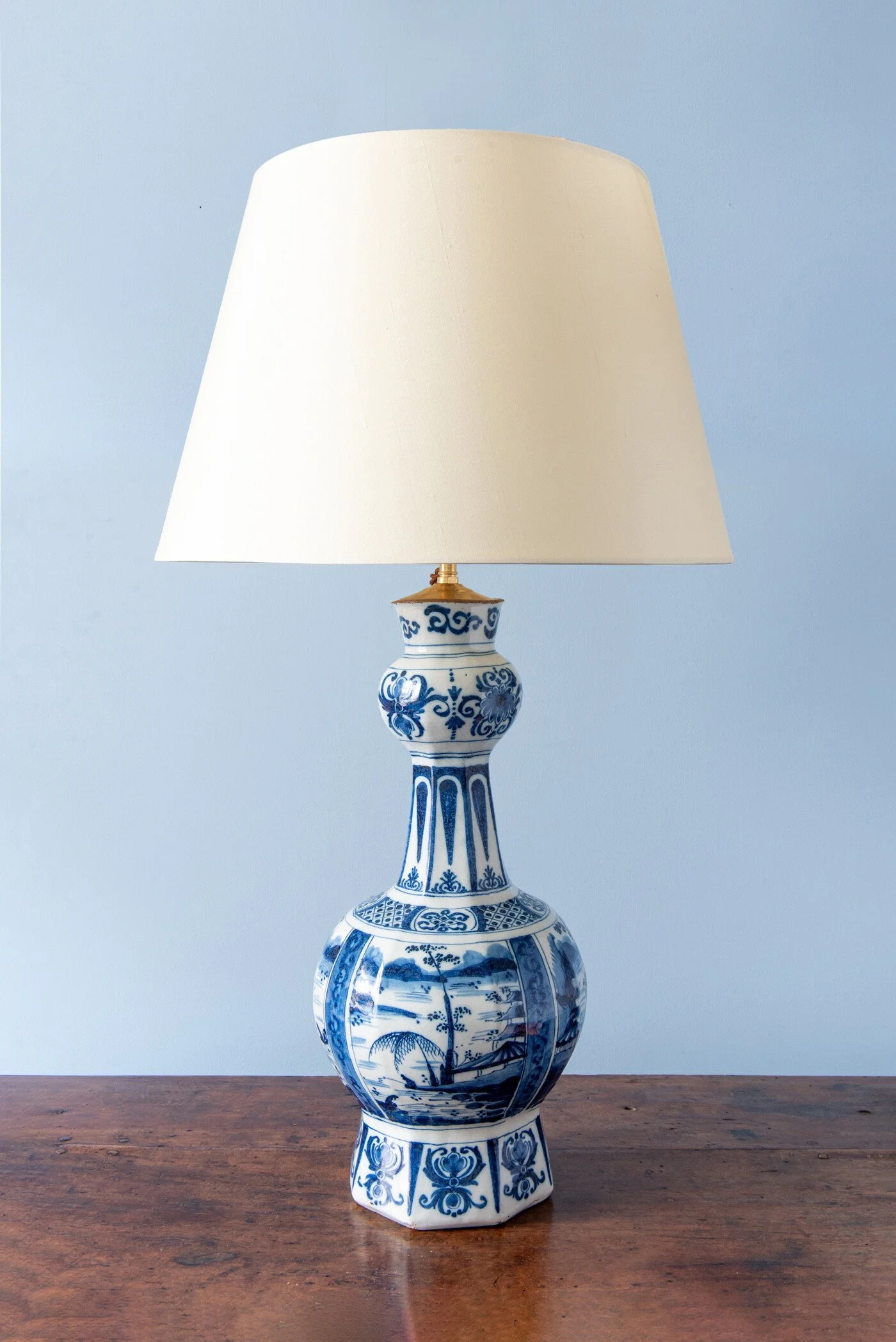
An 18th-century Dutch Delft vase, converted to a table lamp, of classic garlic neck form raised on an octagonal base. Decorated in blue and white with four atmospheric Chinoiserie landscapes, depicting figures seated beside a lake, surrounded by trees and buildings with mountains in the distance. The scenes are rendered with a compelling level of detail, the brushwork alternating between fine linework and painterly washes of blue to create movement and depth.
The base and neck are decorated with an array of scrolls, florals, lambrequins, dots and criss-cross patterns. An impressive piece in scale and execution, with the enduring decorative presence of Delft.
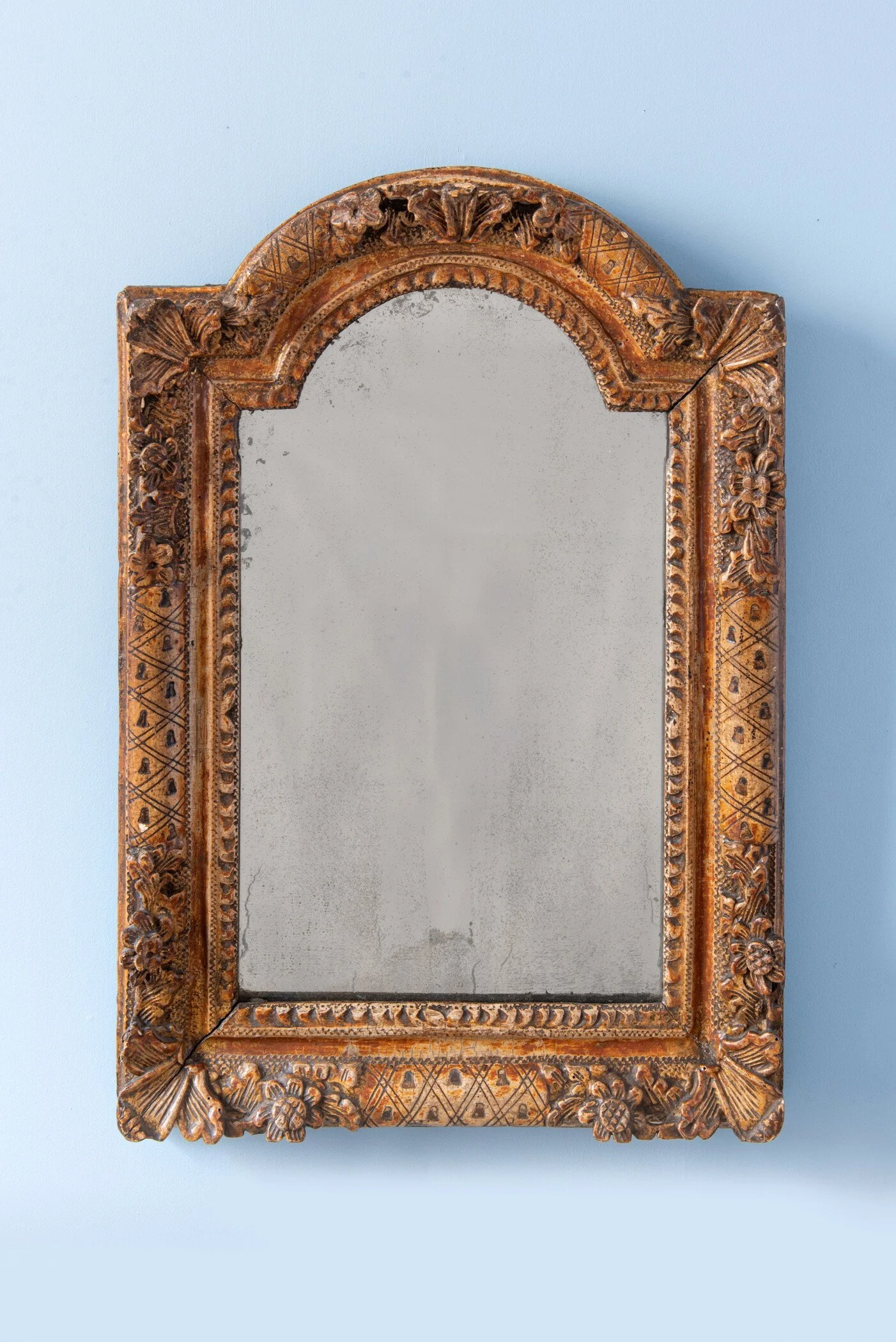
A French gilt gesso mirror of the Régence period, c. 1730, of rectangular form surmounted by an arched top. The frame is adorned with carved flowers and acanthus leaves at the corners and upper section, alternating with cross-hatched bands, and completed by a flat beaded inner slip. The original mercury plate and backing are retained, with gentle foxing. The original gilded finish displays a handsome patina, with the red bole showing through in places.
A rare mirror of medium scale, characteristic of the early Régence style in its combination of boldly carved ornament with the restrained geometry bridging the rigour of Louis XIV and the emerging curves of Louis XV.
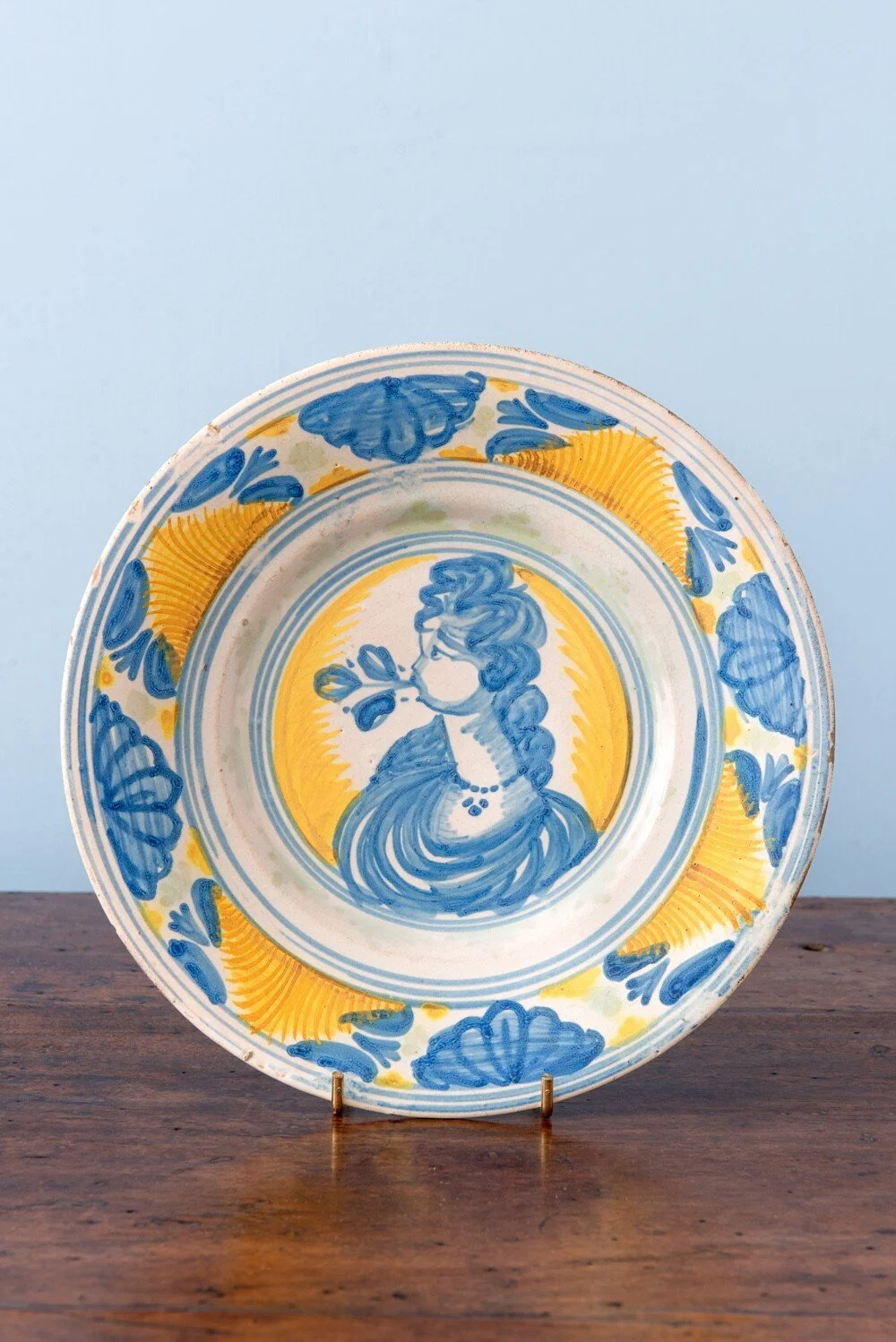
A rare 17th-century Sicilian maiolica plate, c. 1680-1700, likely from Caltagirone or Palermo, painted in a vibrant palette of cobalt blue and yellow on an off-white ground
The central design depicts the bust of a lady in profile, richly dressed with long hair and jewellery, exhaling a delicate stream of flowers or perfume. This allegorical figure is set in a circular reserve defined by blue lines, while the lip features a refined frieze of radiating fans and shell ornaments. Painterly blue brushwork alternates with thin yellow lines to create a dynamic contrast of patterns, softened by touches of light green around the centre and along the frieze.
The playful figure is characteristic of the distinctive portraiture found in Sicilian ceramic production of the 17th-century, in which vases, albarelli and plates frequently feature whimsical portraits with unusual features in free, almost folk-like brushwork. Even within this tradition, this particular motif is notably rare, and compelling brushwork and refined details in the hair, dress and jewellery set is further apart. The frieze patterns recalls the scrollwork of Tuscany and Marche, interpreted with an emphasis on colour over line typical of Southern Italy.
Unrestored and in excellent condition, a rare and captivating plate, exemplifying the charm and spirit of Sicilian maiolica.
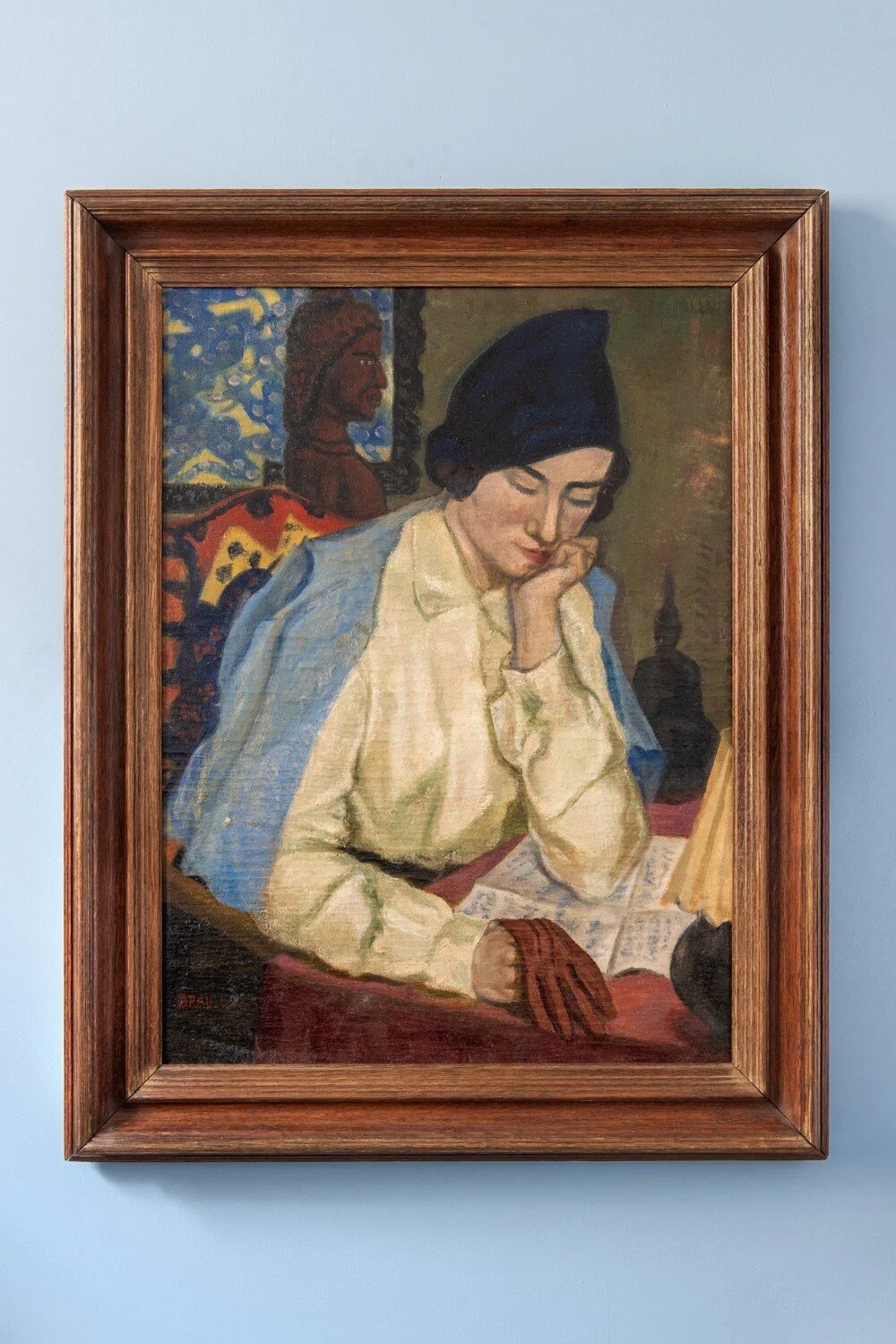
An early 20th-century oil painting on canvas depicting a woman seated at a table, reading a letter with a glove in hand. The sitter’s thoughtful pose creates an intimate, contemplative mood within a quiet interior, layered with bold patterned textiles, vibrant artwork, and an African sculpture in the background. Decorative rhythm guides the eye across the composition, from the folds of the shirt to the sculptural forms of the hat, sculpture, and objects on the table. A restrained palette is heightened by accents of blue and red, and the luminous white of the shirt. The African sculpture and abstract artwork suggest an early modern sensibility, offering insight into the artistic world of the sitter.
Presented in a 19th-century oak frame, signed lower left, and of impressive scale, this rare and distinctive work combines a captivating portrait with a refined early modernist interior, offering strong decorative appeal and a glimpse into an introspective, cultured world.
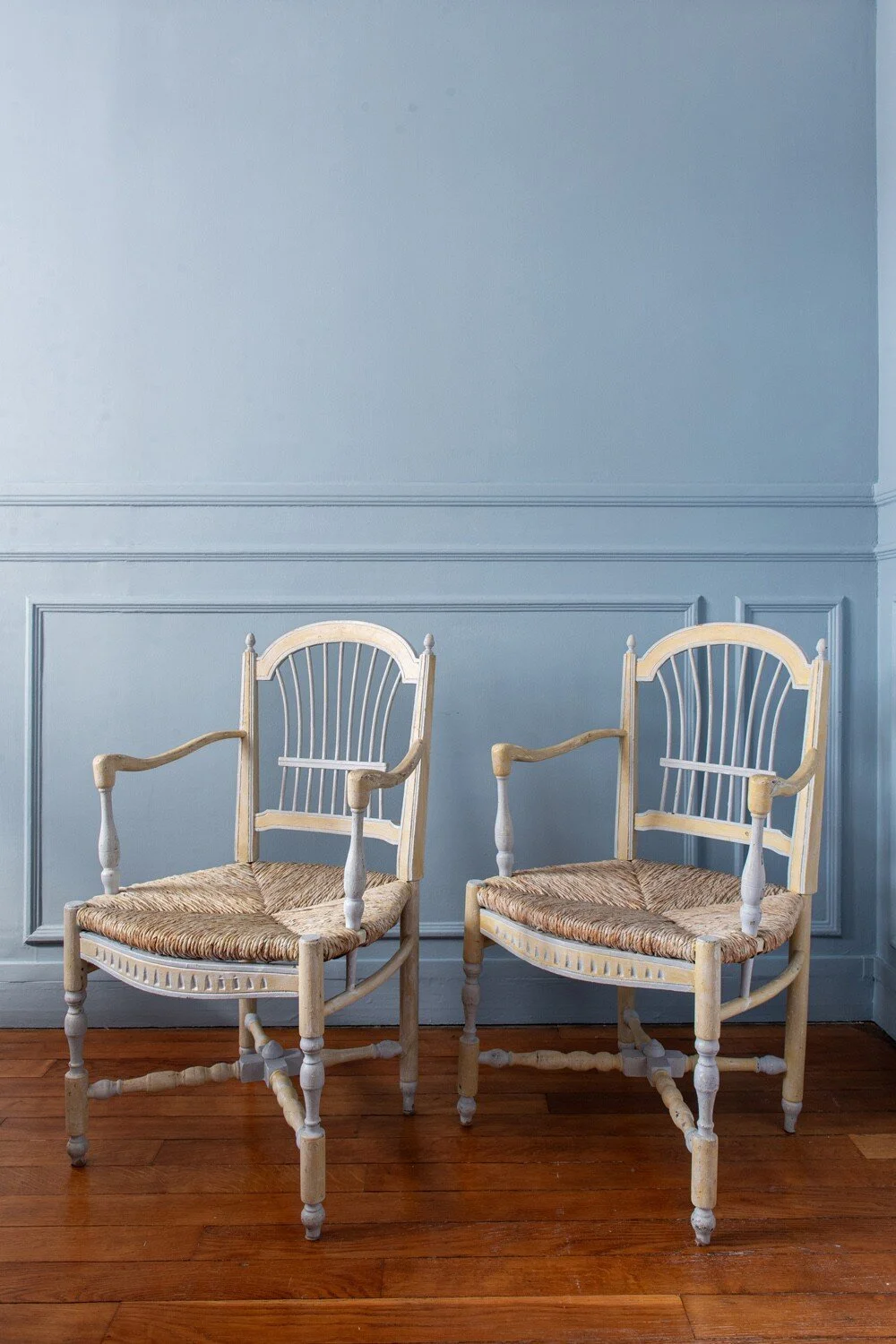
A pair of late 19th-century French rush-seat armchairs from Provence, retaining their original two-tone painted finish in soft yellow and light grey, gently worn to an authentic patina. The arched backs are carved in soft curves with shaped splats, while slightly scrolled armrests rest on turned supports. Rush seats are framed by shaped aprons, and turned legs are joined by an entretoise. With their warm colours and graceful design, this rare pair of rustic armchairs displays Provençal charm and elegant craftsmanship.
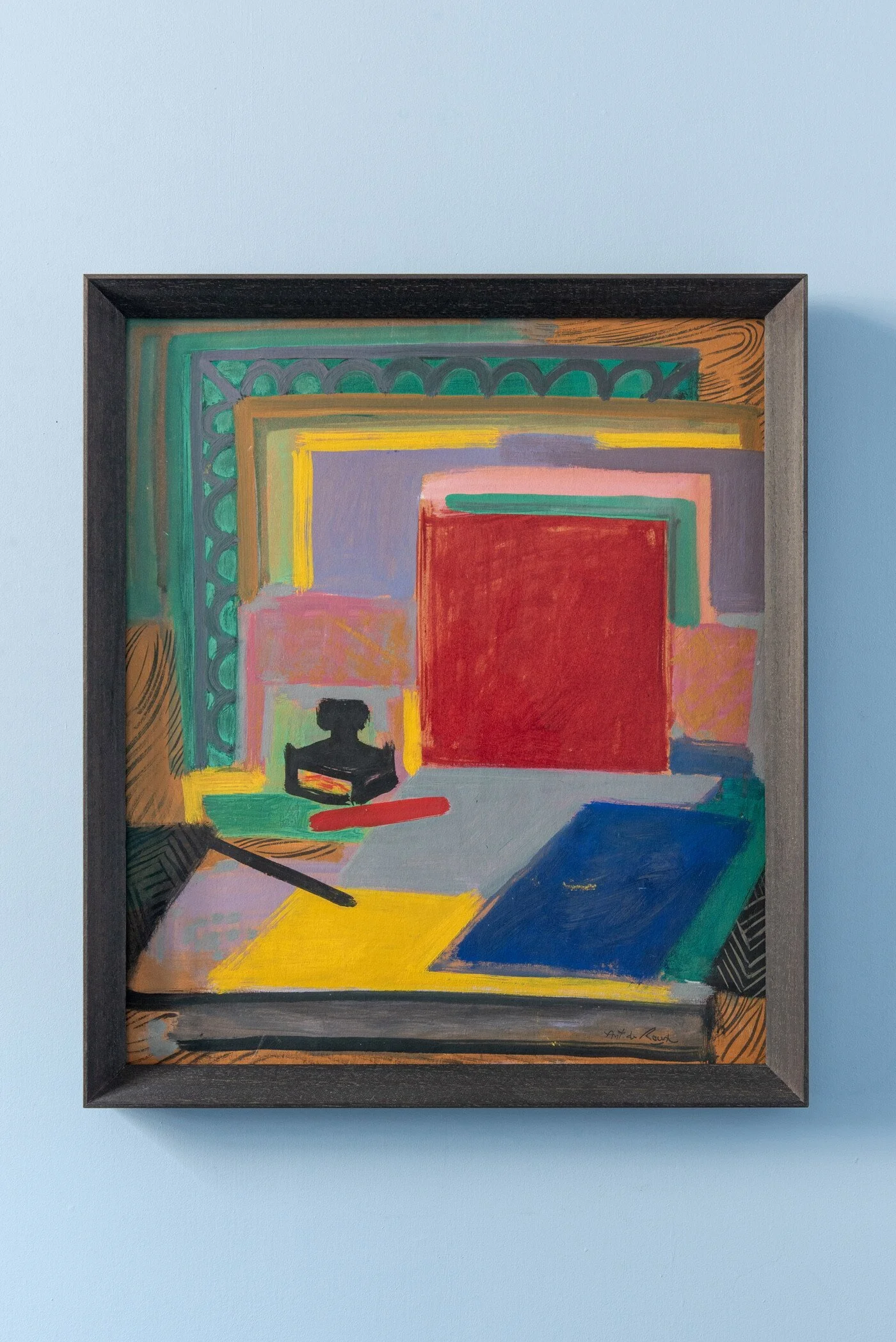
A mid-century gouache on board, c. 1950–1960, by French painter Antoine de Roux (1901-1986), depicting an interior still life centred on an inkwell and pencils, arranged alongside paper cards on a tabletop. The background is animated by an abstract composition of rectangular forms, bordered by a frieze of scalloped motifs, while the overall scene is framed by wood-grain patterns.
A bright and assured palette of red, blue, yellow and green, structured by black accents, gives the composition rhythm through geometric planes of colour and decorative pattern, balancing a sense of perspective with abstraction and colour experimentation.
Signed lower right and presented glazed under museum glass in a dark brown modernist frame. Antoine de Roux worked from the 1930s to the 1960s, focusing primarily on interior scenes and still lifes. While his earlier works retain a naturalistic, almost naïve approach to objects, his later works, such as this one, favour abstraction, while maintaining a consistent interest in interior space, colour structure and decorative presence.
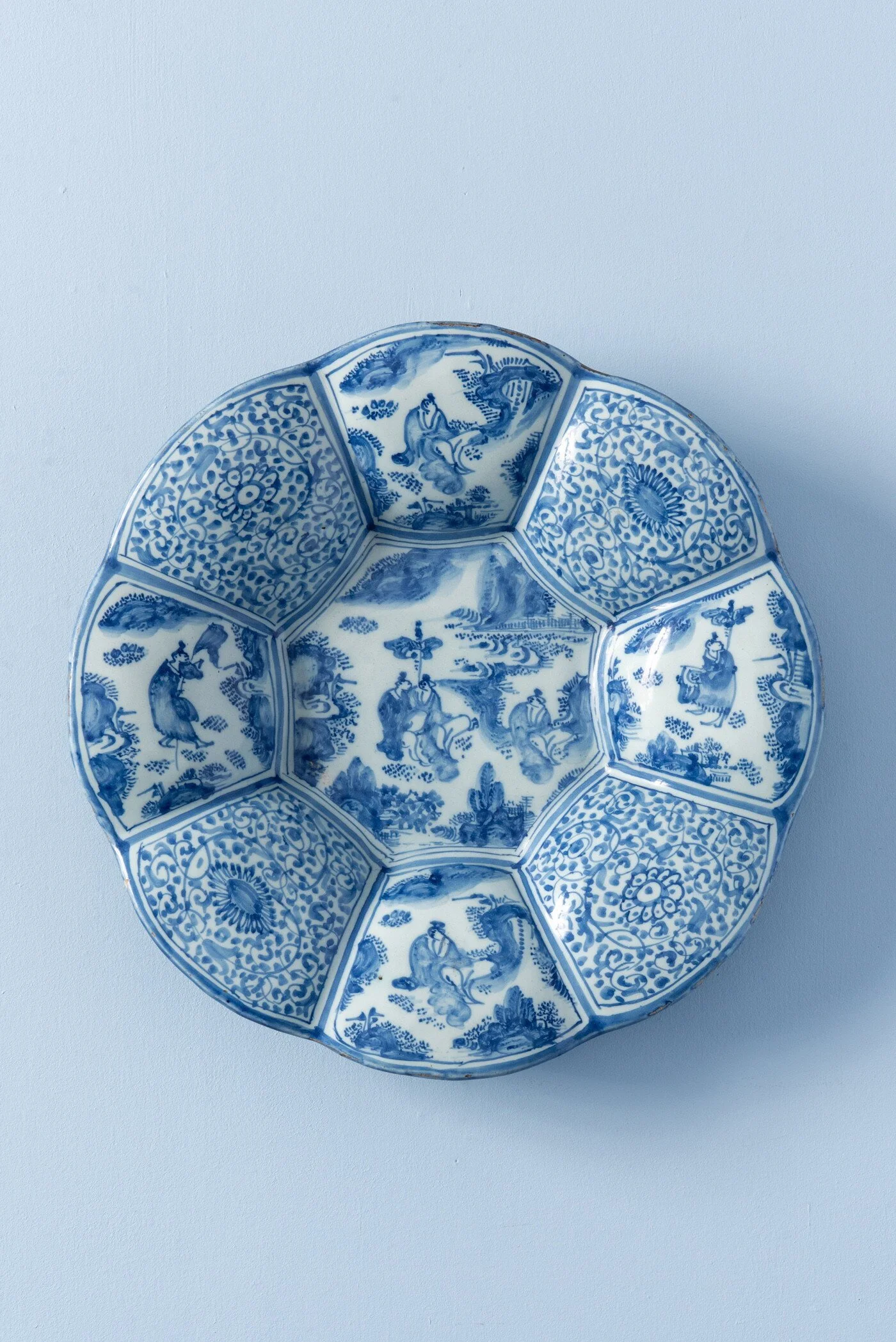
A late 17th-century Dutch Delft dish, c. 1680-1720, of octagonal lobed form, raised on a piedouche. Decorated in blue and white with a glossy glaze of bluish tonality, it features Chinoiserie Kraak-style scenes painted within shaped reserves, depicting figures in lakeside landscapes with bridges, trees and foliage.
These figurative scenes alternate with millefleur reserves, filled with scattered small flowers arranged around a larger central bloom, creating a richly animated surface. The reverse is decorated with fluid geometric motifs of circles and x-marks.
A well-preserved Delft dish, with a graceful shape and captivating decor, equally elegant displayed on a wall or presented on a tabletop.


A provincial French Louis XV cabaret table in walnut, c. 1750. The top features a striking star-shaped parquetry pattern, a regional interpretation of parquet de Versailles, and is bordered by a raised surround characteristic of cabaret tables, originally intended to secure tea or coffee services.
The table includes a single drawer and a delicately scalloped waistband, resting on graceful cabriole legs terminating in stylised hoof feet, all typical of the Louis XV period. Its relatively low height suggests use as an occasional table, combining practical function with elegant proportions.
The use of solid walnut adds warmth and authenticity, creating a striking contrast with the expressive parquetry top and the flowing lines of the legs. A balanced and refined table, with graceful Louis XV forms and distinctive regional craftsmanship.